Showing posts with label Climate Change. Show all posts

Saturday, March 28, 2009

Earth Hour '09 and beyond

I said in an earlier post that I need to stop neglecting this little slice of the 'net, but obviously I have not followed through.

That's not due to lack of interest in the subject matter, mind you. I'm still making the effort to find little ways to to reduce my footprint.

And this year, I plan to participate in Earth Hour.


I was not able to last year because I was at a...huh...professional wrestling event and I was not confident that they would honour my request to turn off the lights and have the matches by candle light.

Let's move on to a good article from the Ottawa Sun today. There are plenty of articles about Earth Hour out there, but I favour this one because it offers suggestions on how to incorporate Earth Hour into the rest of the year.

Here we go:
Earth Hour is set to become the largest global action in human history.

Really? This surprises me because it seemed to be getting far less hype this year. Perhaps it's becoming ingrained, like Earth Day. Why the hell did no one think of Earth Year??

If all goes according to plan, at 8:30 p.m. local time today, one billion people in more than 1,000 cities around the world will be turning off their lights.

The idea is to focus global attention on the need for action on climate change

While the simplicity of the one-hour event makes it powerful, organizers say it's just a start.

"Turning the lights off for Earth Hour is a great first step, but if you really want to see a difference, then make Earth Hour part of your everyday life," says the Earth Hour website.
You hear that, non-believers?

A pet peeve of mine are people who debate by arguing points that aren't being made. You often hear people say "Turning off your lights for one hour isn't going to do a thing to affect the Earth's temperature". No one is saying it will. That's not the intent.

Despite growing concern about climate change, Canada's greenhouse gas emissions increased nearly 22% between 1990 and 2005. By the end of 2006, Canada's total emissions were 29% above the Kyoto target.

The good news is that during the same period, greenhouse gas emissions from Canada's housing sector decreased by 8.5%, despite a 28% increase in housing, reports the Canadian Home Builders' Association. This translates into an average 15% decrease per household.

Interesting stat. I would be curious to know by what method the reduction was achieved.

The most effective way to reduce greenhouse gas emissions is to reduce energy use. According to Natural Resources Canada, within the average Canadian household, 60% of energy is used for space heating, 18% for heating water, and 14% for appliance use. Lighting accounts for 5%, and space cooling 3%. With that in mind, here's a list of suggestions that can reduce household energy use and save money:
More interesting stats. I questioned that having a house full of CFL's was not having the impact that I thought it should (judging from the total of my electricity bill). But if lighting only accounts for 5%, I guess that explains it somewhat.

Here's another thing that struck us though (I may have mentioned this before...I repeat myself constantly): We have CFL's everywhere, and they use about a third of the evergy of "conventional" light bulbs...but almost every light switch in the house will light three or four of them. So...what's the point??

The solution for us then is to be careful as to which ones we actually use. We have a pot light above the shower in the master bathroom. We use that one most because the "main" light switch flicks on four bulbs. Duh.

I'm sorry, I interrupted the list of suggestions. Here it is.

1. Lower your thermostat by just one degree. This can reduce your residential heating bill by as much as 10%, according to Natural Resources Canada. While many Canadians lower their thermostats at night, lowering daytime temperatures, particularly when no one is home, can add up to big energy savings.

2. Install a programmable thermostat and learn how to use it. While 40% of Canadian households have programmable thermostats, an estimated 20% of these don't use them.

3. Switch to cold water in the laundry. Washing in cold water can reduce energy use by 80% and save $100 a year in hot water.

4. Line-dry your clothes. This can cut household energy bills by as much as 15%. As an added bonus, the sun's ultra-violet rays naturally bleach and disinfect clothes, eliminating the need for chlorine bleach and other harsh chemicals.

This reminds me of one of the dumber questions I asked when I got started with my self-imposed training. We were looking into buying appliances for the new house. We made it a point to seek out Energy Star ones. Dishwasher, fridge, washer and...hey, they don't make Energy Star clothes dryers.

"Sure they do," Mrs THIT pointed out, "They call them 'clotheslines'."

Touché.

5. Have a home energy audit. Most provinces now have government Home Energy Audit programs that help offset audit costs and provide grants for energy efficiency improvements.

6. Caulk and weather strip doors and windows. This can reduce heating bills by 25%, according to the David Suzuki Foundation.

7. Use power bars for televisions, DVD players, video game consoles and other electronic equipment. As much as 10% of household electricity is consumed by appliances that are turned off, but continue to draw power in stand-by mode. This referred to as phantom load.

8. Upgrade your appliances. According to the David Suzuki Foundation, replacing a 10-year-old refrigerator with a new Energy Star approved model can save enough energy to light your home for more than three months.

9. Be water-wise. Pumping water is responsible for as much as two-thirds of the total electricity used by municipalities. Take shorter showers, install low-flow toilets and sink aerators. Reducing water use in the shower will also help cut your hot water bill.

10. Educate yourself. Visit www.powerwise.ca

Now here's something I learned; I asked Mrs THIT what she planned to do during that hour and she said something about watching TV or some such.

What what what?? No way! But apparently, that's allowed. You just need to have your lights off, but can use electricity for other purposes.

Nonsense. All electricity is banned here for that hour.

And I won't make the same mistake I made the last time we had a power failure. Somehow, I decided that it would be a good idea to shave by candlelight.

It isn't.

Saturday, November 08, 2008

School of Rock

Interesting.

By Timothy Gardner

NEW YORK (Reuters) - A rock found mostly in Oman can be harnessed to soak up the main greenhouse gas carbon dioxide at a rate that could help slow global warming, scientists say.

When carbon dioxide comes in contact with the rock, peridotite, the gas is converted into solid minerals such as calcite.

Geologist Peter Kelemen and geochemist Juerg Matter said the naturally occurring process can be supercharged 1 million times to grow underground minerals that can permanently store 2 billion or more of the 30 billion tons of carbon dioxide emitted by human activity every year.

Their study will appear in the November 11 edition of the Proceedings of the Natural Academy of Sciences.

Peridotite is the most common rock found in the Earth's mantle, or the layer directly below the crust. It also appears on the surface, particularly in Oman, which is conveniently close to a region that produces substantial amounts of carbon dioxide in the production of fossil fuels.

/

They also calculated the costs of mining the rock and bringing it directly to greenhouse gas emitting power plants, but determined it was too expensive.

The scientists, who are both at Columbia University's Lamont-Doherty Earth Observatory in New York, say they could kick-start peridotite's carbon storage process by boring down and injecting it with heated water containing pressurized carbon dioxide. They have a preliminary patent filing for the technique.

They say 4 billion to 5 billion tons a year of the gas could be stored near Oman by using peridotite in parallel with another emerging technique developed by Columbia's Klaus Lackner that uses synthetic "trees" which suck carbon dioxide out of the air.

More research needs to be done before either technology could be used on a commercial scale.

Peridotite also occurs in the Pacific islands of Papua New Guinea and Caledonia, and along the coast of the Adriatic Sea and in smaller amounts in California.

Big greenhouse gas emitters like the United States, China and India, where abundant surface supplies of the rock are not found, would have to come up with other ways of storing or cutting emissions.

Rock storage would be safer and cheaper than other schemes, Matter said.

Many companies are hoping to cut their greenhouse gas emissions by siphoning off large amounts of carbon dioxide from coal-fired power plants and storing it underground.

That method could require thousands of miles of pipelines and nobody is sure whether the potentially dangerous gas would leak back out into the atmosphere in the future.

My only concern would be that people would treat this as the miracle cure (note that scientists believe it would "slow" global warming, not stop it). Let's not bother to even try to reduce emissions, we've got our magic rock. Kind of like the people who think that switching to Diet Coke means they can eat whatever they want and lose weight.

Sunday, October 05, 2008

Go Green Tube

Are you like me? Are you totally fascinated by Stephane Dion's peculiar accent when he speaks English (or a somewhat reasonably facsimile)?

A strange mix of the lawyer in "The Usual Suspects" and the voodoo chick in the "Pirates of the Caribbean" series of movies, it has the effect of an auditory train wreck on me; I simply can not pull myself from listening to it.

Well, thanks to Go Green Tube, I can listen to it to my heart's content (which means, basically, until the end of eternity or until Steph or I die, whichever comes first). And I'll save the planet while doing so, and hopefully get some more green tips.


What is Go Green Tube?! Well I'm glad you asked! It's like youtube but...huh...green. Here's what they say:

We believe good actions deserve to be acknowledged and rewarded, so for every video you as a member watch, we will offset a pound of carbon. The more you watch, and the more friends you bring here, the more difference you make!

Well, all right. In addition to Dion's siren-like voice (and I mean more the ambulance or fire truck type of siren than the half-fish, long-haired, topless chicks kind), I'm going to poke around for some more personal tips that I can apply from THIT World Headquarters. Sign up and take a look around, maybe you'll find something you like.

Happy viewing!

Saturday, May 31, 2008

Eco-Tube

This was posted on the Green Party's Facebook page. Much the same as youtube, eco-tube is a video upload site with a focus on environmental news, tips, etc.

Here, for example, is a message from the Blue Man Group, in their typically odd fashion. I absolutely love these guys. I made a trip to Las Vegas a few years ago and my primary goal was to attend their performance at the Luxor. Mission accomplished, only to find out that they were coming to Toronto the following year. And now they're coming to Ottawa, so I'll try to attend that as well.


Sunday, March 02, 2008

Carbon Tax Coming to BC

Speaking of British Columbia in the previous post, I look forward to seeing the results of their attempts to impose a carbon tax.

Let's have a look at highlights from a Vancouver Sun article.

(Finance Minister Carole) Taylor said the new carbon tax will kick in July 1. Initially, drivers will pay about 2.4 cents per litre more for gasoline at the pumps.

The tax will apply to virtually all fossil fuels, including gasoline, diesel, natural gas, coal, propane and home-heating fuel. It will rise each year, reaching 7.2 cents per litre of gasoline -- and comparable amounts on other fuels -- by 2012.

After that, Taylor said, it will be up to the government of the day to decide what to do with the tax.

If you drive a Prius hybrid, the government estimates the new tax will cost you about $20 extra per year at the outset, rising to $60 by 2012. If you drive a Dodge Ram pickup truck, the additional cost will be closer to $68, rising to about $204 by 2012.


Ah, but will the hybrid help you compensate for...never mind. ;-) I do like seeing these numbers included though. If people struggle to relate to the cost of pollution, they can usually relate to the impact on their wallets.

If you use natural gas to heat your home and water, the carbon tax will push up your costs an average $60 this year, rising to $180 by July 2012 -- unless you change your current heating or water-use patterns.


This is where I find many people need to smarten up; home heating and cooling. We know people who keep their houses at 22 in the winter and 17 in the summer. It's insane on a financial basis, if nothing else.

First off, we actually keep the house at 17 in the winter. But every curtain and blind in the house is open. The heat from the sun alone heats the house to 21, so the furnace doesn't run most of the afternoon. And no, I don't walk around the house wearing four layers and gloves.

Having the air-conditioning at 17 in the summer is even more stupid. I think of it this way; if you went on a Caribbean vacation in February, and it was 17 degrees the whole time you were there, you'd probably be a little disappointed. Well, hell, don't do it at home then! Keep the AC at 20 or thereabouts so it's still a refreshing change from the heat and humidity outside, but there's no need to waste energy and coin by simulating Antarctica in your living room.

Hydro rates are also expected to go up, though those increases are not directly linked to the carbon tax and so will not be balanced by any tax breaks. Hydro rates are expected to increase $60 this year, and another $60 next year.

To help people deal with these increases, the government is offering incentives such as provincial sales tax exemptions for energy-efficient appliances and other tax relief for the purchase of fuel-efficient vehicles.

To help people adjust to the tax -- which seeks to achieve about 7.5 per cent of the government's legislated reductions by 2020 -- all British Columbians will receive a one-time $100 cheque in June.

"We want to bring in the benefits first," Taylor said. She added that the one-time payment will be in addition to the matching tax reductions and credits.

To make the carbon tax truly revenue-neutral, Taylor said, corporate taxes will drop from 12 per cent to 11 per cent on July 1, and then to 10 per cent by 2011.

Small-business taxes will also be cut, from the current 4.5 per cent to 3.5 per cent on July 1, and then down to 2.5 per cent by 2011.

Personal provincial income taxes will be cut by five per cent in 2009 for the first $70,000 of earnings.

Lower-income British Columbians will receive further credits in the form of an annual "climate action credit" of $100 per adult and $30 per child.


I like that the article makes it clear that this is a tax shift, not an increase. Very often, a carbon tax is described as an additional tax as opposed to a redistribution.

I actually look forward to criticism about this. Further in the article, one person comments that the increase in gas prices did not stop people from driving, so adding a little more to it will likely accomplish nothing. I did a quick search to try to find out how successful this has been in parts of Europe but I have yet to locate anything decisive (probably because it has yet to be fully determined). So let's make it a date to review this in 2011 and see where things stand.

Sunday, December 23, 2007

2007 Seventh-Warmest Year on Record

I know many people are sick and tired of hearing it, but...

BBC News - This year has been one of the warmest since 1850, despite the cooling influence of La Nina conditions, according to scientists.

The UK's Hadley Centre and University of East Anglia conclude that globally, this year ranks as the seventh warmest.

The 11 warmest years in this set have all occurred within the last 13 years. For the northern hemisphere alone, 2007 was the second warmest recorded.


I mention it because, when we received 35+ centimeters of snow in one day recently, the inevitable comments that global warming must be a hoax or mistake were heard again. So if I follow the reasoning, scientific research is to be immediately invalidated in favour of a snow storm in mid-December.

Is that to say that scientists are never wrong? Of course not. I've admitted a number of times that I'm not a full believer in global warming, or climate change, or whatever name you want to give it.

I also don't believe the excuse, used by those who don't want to change their habits, that adapting against climate change will ruin the economy. Ridiculous. Individuals can take it upon themselves to do their little part and make a significant difference. But I suppose that taking the stance that inaction is doing the world a favour is comforting to those who can't do away
with their little luxuries, like driving to their mailboxes.

You may have seen this gentleman's original video before. He broke down the logic of acting as though climate change is a fact very clearly. He apparently has updated it to cover a hole in his original video, so if watching this version feels as though you're watching a sequel, well, you are. And he's made more since, including a 4-part series since called "The Solution".


He dares you to punch a hole in his theory. So by all means, if you feel that a snow storm in December trumps his entire argument for a common sense approach, write to him and set him straight.

Friday, June 01, 2007

Global Warming: A Guide to the Perplexed.

New Scientist Magazine attempts to resolve a number of claims in relation to global warming, climate change, whatever you want to call it. While I prefer to err on the side of caution regardless, there are some claims that occasionally cause me to question the whole thing.

I have yet to read then entire article, but I believe it will make for good reference material. Here it is.

Wednesday, February 14, 2007

Monday, December 25, 2006

This is Green I Don't Need.


Even though green is a Christmas colour, and I don't recall ever stating that I'm a big fan of winter, I'd rather be knee-deep in snow right now than seeing grass everywhere.

I probably come off as a bigger believer in global warning than I really am. In all things that can not be proven "beyond the shadow of a doubt", I prefer to allow for the possibility that I'm wrong.

However, I also prefer to err on the side of caution. If I make my token effort to prevent it, and have a little fun with it in the process, and find out that global warming is actually a bunch of nonsense, what's the worst damage I can do? Help reduce pollution? That doesn't sound so bad...

But a green Christmas goes a little further in making me a true believer. I don't recall my last green Christmas. In fact, I'm not sure I've ever seen one before. But if my recollection is sound, all but one of the last four of five have been close. And this year, here it is.

Ah well. I'll go on considering the possibility that it's a fluke, but act as if it isn't. In fact, Mrs THIT and I are enjoying preparing the new house to be as green as possible, both in terms of being environmentally conscious and from a financial perspective. We've begun the search for our appliances and will not purchase anything that isn't Energy Star certified. If the house itself is, it doesn't make sense to add appliances that are not.

Merry Christmas to all friends and family who read this on occasion and to all the people who happen to be wandering by. And if you're among those wanderers and are offended that I'd specify Christmas instead of "holidays" or what-not, well...your skin's too thin. ;-)

Tuesday, November 14, 2006

Crickey!

Another nutty coincidence...

CANBERRA, Australia - The drought gripping Australia could be the worst in 1,000 years, government officials said, as Australia started to draw up emergency plans to secure long-term water supplies to towns and cities.

The drought affecting more than half of Australia’s farmlands, already lasting more than five years, had previously been regarded as the worst in a century.

But officials from the Murray-Darling river basin commission told a water summit of national and state political leaders on Tuesday that analyses of the current prolonged drought now pointed to the driest period in 1,000 years.

/

A spokeswoman for the Murray-Darling Basin Commission said the current consecutive years of drought had not been observed in the 114 years since records were first kept.

She said mathematical and probability analyses of the current dry spell found Australia was moving into what was possibly a one-in-1,000-year drought.

“We don’t have the records to substantiate a one-in-100-year drought any more -- it’s beyond that,” she told Reuters.

Lack of winter rain has meant record-low inflows into the Murray-Darling river system, which drains an area the size of France and Spain combined and provides water to Australia’s major agricultural areas.

The average inflow of water into the Murray River, which flows through three states, is 11,000 gigaliters a year. In the past five months it has received less than 600 gigaliters. One gigaliter is one billion liters.

Green groups have warned that towns and cities along the river system could run out of water if the drought goes into another year.

Prime Minister John Howard used the water summit to announce moves to investigate how to secure log-term water supplies for towns and cities along the Murray River.

The summit also approved a new weir across the Murray to provide emergency water, if needed, for the South Australian capital of Adelaide, a city of about one million people, which draws 40 percent of its drinking water from the Murray River.

But Howard, who remains skeptical about the impact of global warming, declined to publicly declare the drought the worst in 1,000 years. “All I know it is a very bad drought. It is the worst in living memory,” Howard told reporters.

Wednesday, September 27, 2006

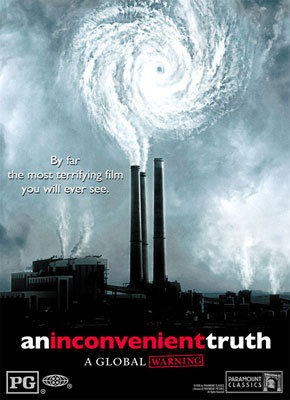
An Inconvenient Read

I was at the gym earlier today, bustin' my glutes, when between exercises I happened by the magazine counter they have there. They never have anything good (they're mostly geared towards women, and I can't get behind articles entitled "Learn how to get your man to do what YOU want!") but I scoped it anyway.

I came upon a mag called Western Standard (if I recall correctly). Seems less like a publication about the Western provinces than an infomercial for the Conservative government, but I leafed through it anyway.

There's a movie review in there for An Inconvenient Truth. Seemed a little late for that, but the magazine was dated July 3rd.


Not everyone likes this flick. And generally speaking, I don't care if someone doesn't like something that I do, if they can at least give me a reasonably valid reason. Even if I disagree with it, I'll at least respect the opinion.

This review contained a criticism of Inconvenient Truth that I've read both before and since seeing it; that Al Gore is long on theories, but short on solutions.

Bullshit. While the end credits run, they list all kinds of ways by which you can reduce your impact on the environment. The movie leads you right into it!

It's amazing to me that anyone can miss it, but at least it speaks volumes about both the accuracy and the mindset of the person writing the review.

Saturday, September 02, 2006

Shush! Dave's Talking...


Unfortunately, it seems not enough people are listening. Here's an abbreviated newsletter article from David Suzuki in which he discussed the results of a study done using a focus group.

...Recently, my foundation conducted a focus group about global warming to see where people are at in their understanding of this complex and challenging problem. The results? Let's just say they were disconcerting, to say the least.

Simply put, most people don't have a clue. The majority felt that global warming was a very important problem and they were quite concerned about it. But when pressed as to why it was a problem or what caused the problem, all heck broke loose.

Apparently, according to the average Joe, global warming is happening because we've created a hole in the ozone layer, allowing the sun's rays to enter the atmosphere and heat up the earth - or something like that. The cause of the problem is cars, or airplanes, or aerosol cans. No one really knows for sure.

This is really quite remarkable. I would have thought that such confused understandings of the issue would have been commonplace five or six years ago, but with global warming being in newspapers on practically a daily basis this spring, on the front cover of magazines, in theatres (An Inconvenient Truth), and a hot political issue as well, surely people would get it by now.

Apparently I was wrong. People don't get it. This is a big problem, because if people don't get it, then they don't really care, so politicians and CEOs don't really care, and status quo rules the day. And blindly we march into the sunset.
/
So, to clarify - the ozone layer is a part of the atmosphere way up high that helps shield the earth from the sun's most harmful rays. A couple of decades ago, scientists realized that some of the chemicals we were using in our industries and homes were finding their way into the upper atmosphere, reacting with the ozone and destroying it. Scientists were concerned that if this continued, it would thin the vital protective layer, leading to increased skin cancers and crop damage. They sounded the alarm bell, the international community responded with the Montreal Protocol to phase out ozone-depleting substances, and today the ozone layer is gradually healing itself.

Global warming is a quite different phenomenon. Again, it's a human-made problem, but this time it's due to the heat-trapping gases we are putting into the atmosphere from our industries, cars and homes. These gases act like a blanket, keeping more heat near the earth's surface. More heat also means more energy in the atmosphere, which means more frequent or severe extreme weather events like droughts, storms and floods.
/
So if you understand what global warming is, and what it isn't, please tell your friends. Please speak up and help ensure that we don't continue to grope blindly into the future, searching in the darkness for a light switch. Because at this rate, by the time we finally reach it, it may no longer work.

Sunday, February 05, 2006

NASA Chief Backs Agency Openness.

A follow-up to a story I included earlier, about a gentleman who claimed that NASA was suppressing some of the information that he was trying to share with the public:

A week after NASA's top climate scientist complained that the space agency's public-affairs office was trying to silence his statements on global warming, the agency's administrator, Michael D. Griffin, issued a sharply worded statement yesterday calling for "scientific openness" throughout the agency.

"It is not the job of public-affairs officers," Dr. Griffin wrote in an e-mail message to the agency's 19,000 employees, "to alter, filter or adjust engineering or scientific material produced by NASA's technical staff."

The statement came six days after The New York Times quoted the scientist, James E. Hansen, as saying he was threatened with "dire consequences" if he continued to call for prompt action to limit emissions of heat-trapping gases linked to global warming. He and intermediaries in the agency's 350-member public-affairs staff said the warnings came from White House appointees in NASA headquarters.

Other National Aeronautics and Space Administration scientists and public-affairs employees came forward this week to say that beyond Dr. Hansen's case, there were several other instances in which political appointees had sought to control the flow of scientific information from the agency.

They called or e-mailed The Times and sent documents showing that news releases were delayed or altered to mesh with Bush administration policies.

Monday, January 30, 2006

This helps.

I posted a little earlier about not really knowing what to believe when it comes to global warming, since different sources give different theories. One NASA employee spoke to support the belief in global warming, and yet the very same man finds himself making the news again...
NY Times:

The top climate scientist at NASA says the Bush administration has tried to stop him from speaking out since he gave a lecture last month calling for prompt reductions in emissions of greenhouse gases linked to global warming.

The scientist, James E. Hansen, longtime director of the agency's Goddard Institute for Space Studies, said in an interview that officials at NASA headquarters had ordered the public affairs staff to review his coming lectures, papers, postings on the Goddard Web site and requests for interviews from journalists.

Dr. Hansen said he would ignore the restrictions. "They feel their job is to be this censor of information going out to the public," he said.

Toast the Earth!

Never let it be said that Treehuggers don't have a sense of humour, I guess...Check out the Toast the Earth cartoon!

Not sure if it'll work, so my apologies if I got it wrong.

Wednesday, January 25, 2006

Is It Getting Hot in Here?

Or is that only in Calgary? :-)

Here's kind of what I was talking about in my first post about struggling to determine who to believe:

Global warming skeptics have regularly put forth the theory the comparative warmth of cities via the "urban heat island effect" -- whereby metropolitan areas register considerably higher temperatures than their surroundings -- has skewed the global temperature record. For instance, at JunkScience.com, a website founded by Steven Milloy, who has claimed that global warming represents "flawed science," a September 12, 2004, article suggested that the urban heat island effect "create[s] the illusion of 'global warming.'

Meanwhile, NASA says...

A NASA official said researchers have calculated that 2005 produced the highest annual average surface temperature worldwide since they began keeping records in the late 1800s.

James Hansen, of NASA's Goddard Institute for Space Studies, said they can't be 100 percent certain of last year's record warmth because they had to estimate temperatures at the Arctic. However, Hansen said he's "reasonably confident" that last year was the warmest year.
.
.
.
Earth is now the warmest it's been in 10,000 years.
Ah. So who do you believe?

I think my strategy with this one is to err on the side of caution. If I'm wrong that Global warming is real, what's the worst that could happen? I'd look like an idiot. Big deal. Not the first or last time. In fact, if I stopped doing it, I think I'd miss it in a weird kind of way...